
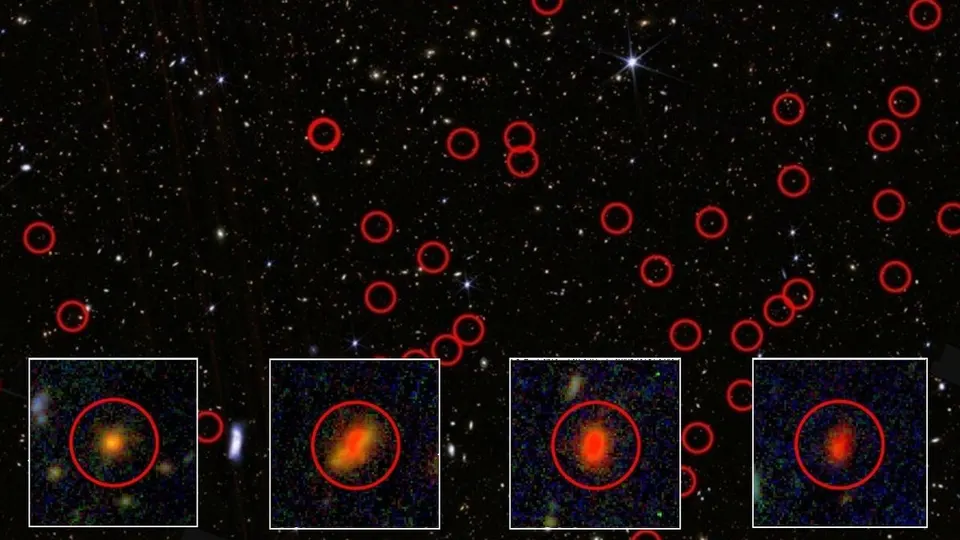
A cosmic puzzle
Since it began observing, Webb has found hundreds of compact, bright red objects in the early Universe that no existing theory predicted. Each is only a few hundred light-years across, yet they shine as brightly as much larger galaxies. Their light also has an unusual V-shaped spectrum, and they give off no detectable X-rays or radio waves. Earlier ideas included compact star clusters, hidden black holes, giant stars and “black hole stars.” None of them could fully explain how these objects formed, why there are so many, how long they last, and what their light looks like.
The new explanation
Using advanced cosmological simulations, Dr. Daniel Whalen of Portsmouth’s Institute of Cosmology and Gravitation and his colleagues propose that Little Red Dots are young galaxies with “direct-collapse” black holes. These black holes formed when huge primordial stars collapsed. Each is about 10 million times the mass of the Sun and is still wrapped in the dense disc of gas that fed it. That gas absorbs X-rays but lets ultraviolet, visible and infrared light through, which matches what Webb sees. A nearby cluster of about 100 million stars, spanning roughly 500 light-years, accounts for the blue part of the light. The model matches many of the Little Red Dots Webb has observed, including some of the most distant and extreme ones.
Why it matters
The finding could help explain how some of the Universe’s largest black holes formed less than a billion years after the Big Bang. Simulations have predicted these objects for decades, and Little Red Dots may be the first evidence that they exist. In Whalen’s words, “we may be witnessing the birth of the first supermassive black holes.”
Discoveries like this begin with a question and reach the world through publication. At ScienceBank, we help researchers share their work with the world.
Source: University of Portsmouth, “James Webb Telescope’s controversial ‘Little Red Dots’ finally explained,” November 10, 2026. Study: The Astrophysical Journal Letters.